
Буря мглою...
Winter Evening

For a few years in his mid-20s, Pushkin lived in exile at his family estate, Mikhailovskoye. This was his most productive period, and arguably the peak of his creativity.
The poem Winter Evening, known to many Russians by its first line, “Буря мглою…”, written during the Mikhailovskoye years, has long been part of the school curriculum and and an integral part of the Russian cultural code.
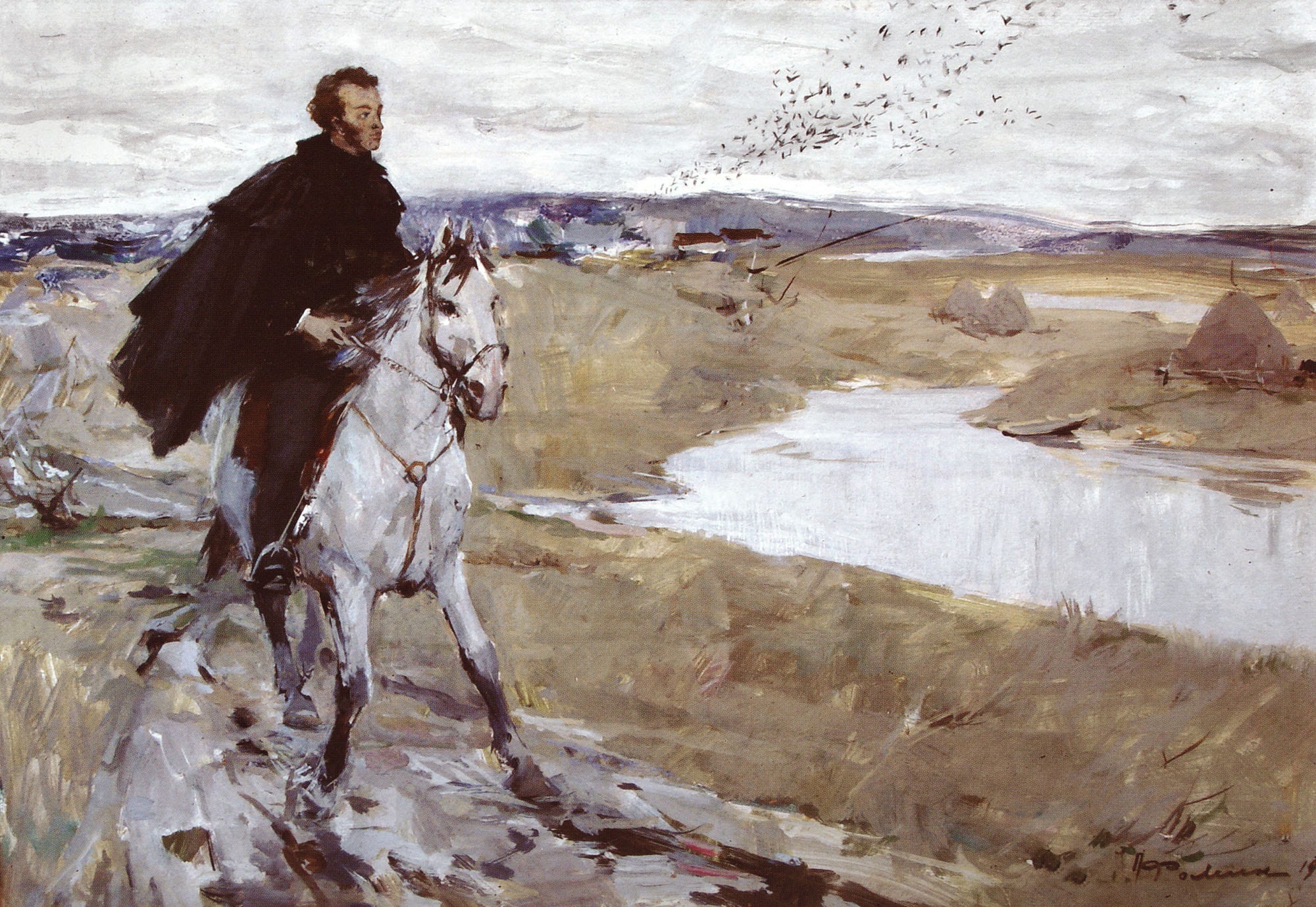
Pushkin on his way from Trigorskoye to Mikhailovskoye by P. Fomin
Listen to the first four lines performed by Igor Kvasha:
Буря мглою небо кроет,
Вихри снежные крутя;
То, как зверь, она завоет,
То заплачет, как дитя…
Let’s start off the top, reading it in small parts, adding new words along the way and making sense of the poem.
Буря кроет - The storm covers
Крыть, покрывать, укрывать are generally synonyms, and can be used both literally and metaphorically:
Два слоя краски покрывают поверхность изделия.
Two layers of paint cover the surface of the product.
Мать укрывает ребёнка одеялом.
A mother covers her child with a blanket.
Купола в России кроют чистым золотом —
Чтобы чаще Господь замечал. — В. Высоцкий
In Russia, domes are covered with pure gold—
So that God may notice them more often. — V. Vysotsky
Also colloquial:
Крыть кого-либо матом - To swear at someone
Буря небо кроет - The storm covers the sky
Word order in Russian sentences is not heavily restricted. On the contrary, words can be shifted around to change the tone or even the meaning. So all the following examples will be correct, although each carries a different nuance.
Буря небо кроет.
Буря кроет небо.
Кроет буря небо.
Кроет небо буря.
Небо кроет буря.
Буря мглою небо кроет - The storm covers the sky with haze
The Russian word мгла (haze) has two instrumental forms—мглой and мглою. Мглой is the standard modern form, and мглою carries a more archaic or poetic flavor.
Буря мглою небо кроет, вихри крутя - The storm covers the sky with haze, spinning whirlwinds
Крутя is an adverbial participle (деепричастие in Russian), derived from the verb крутить (to spin), similar to an English gerund, but different in that it expresses an additional action occurring simultaneously with or in connection to the main action кроет крутя (covers while spinning).
We talked more about adverbial participle before:

Буря мглою небо кроет,
Вихри снежные крутя -
The storm covers the sky with haze,
Spinning snowy whirlwinds
Here, the adjective снежные describes the noun вихри and agrees with it, so both are in the plural, вихри снежные (snowy whirlwinds).
We are done with the first two lines. Let’s put them aside for now and move on to the next one.
Она завоет - It will howl
Here the pronoun она refers to the subject буря (the storm). Unlike with “it” in English, Russian language has no dedicated pronoun for inanimate objects. Instead, the pronouns он, она, and оно must agree in gender with the noun they replace.
Как зверь, она завоет - Like a beast, it will howl
Again, the word order is the author’s choice.
Both options,
Как зверь, она завоет, and
Она завоет, как зверь
are grammatically correct, but Pushkin chose this particular order to heighten the drama and, of course, to generate the poem’s rhythm.
То, как зверь, она завоет - At times, like a beast, it will howl
And now - to the fourth line:
То заплачет - At times it will cry
Either the noun буря or the pronoun она is implied here. Omitting the subject in this clause is normal. It is clear from the context.
То заплачет, как дитя - At times it will cry like a child
Let’s bring last two lines together:
То, как зверь, она завоет,
То заплачет, как дитя…
At times, like a beast, it howls,
At times it weeps like a child.
Here, we need to note two interrelated features of Russian grammar.
First, the conjunction то... то in Russian is a correlative, or paired conjunction, often translated into English as at times... at other times or sometimes... sometimes.
We discussed this before in more details:

Secondly, аlthough the verbs завоет and заплачет are in the future tense, the narration itself remains in the present, an so it translates as such. In storytelling, the Russian future tense can be used to show repeated or recurring actions. This often appears in constructions with paired conjunctions like то… то, то ли… то ли, ни… ни.
Now you must be well prepared to read all four lines together. But first, listen to Igor Kvasha reading these lines one more time:
Буря мглою небо кроет,
Вихри снежные крутя;
То, как зверь, она завоет,
То заплачет, как дитя…
Naturally, this classic poem has been translated numerous times. Allow me to offer two translations of our four lines.
Translation by Martha Dickinson Bianchi:
Sable clouds by tempest driven,
Snowflakes whirling in the gales,
Hark—it sounds like grim wolves howling,
Hark—now like a child it wails!
Translation by Walter May:
Dark with storm the sky is scowling,
Snowy whirlwinds spinning wild;
Now like savage beasts it’s howling,
Now it whimpers like a child.
The poem was set to music more than once. Now listen to these same lines (plus four more) performed by the Kuban Cossack Choir.
For those of you who would like to upgrade your subscription during this Christmas season, I’ve created a special offer: 50% off an annual subscription for the first year. This will give you access to my posts on Russian grammar, which are normally available only to paid subscribers. The offer is valid until January 7, when most Russian and other Orthodox Christians celebrate Christmas according to the Julian calendar.
Beautiful. Thank you for your effort to explain.