
Чужой каравай
Someone else's loaf of bread

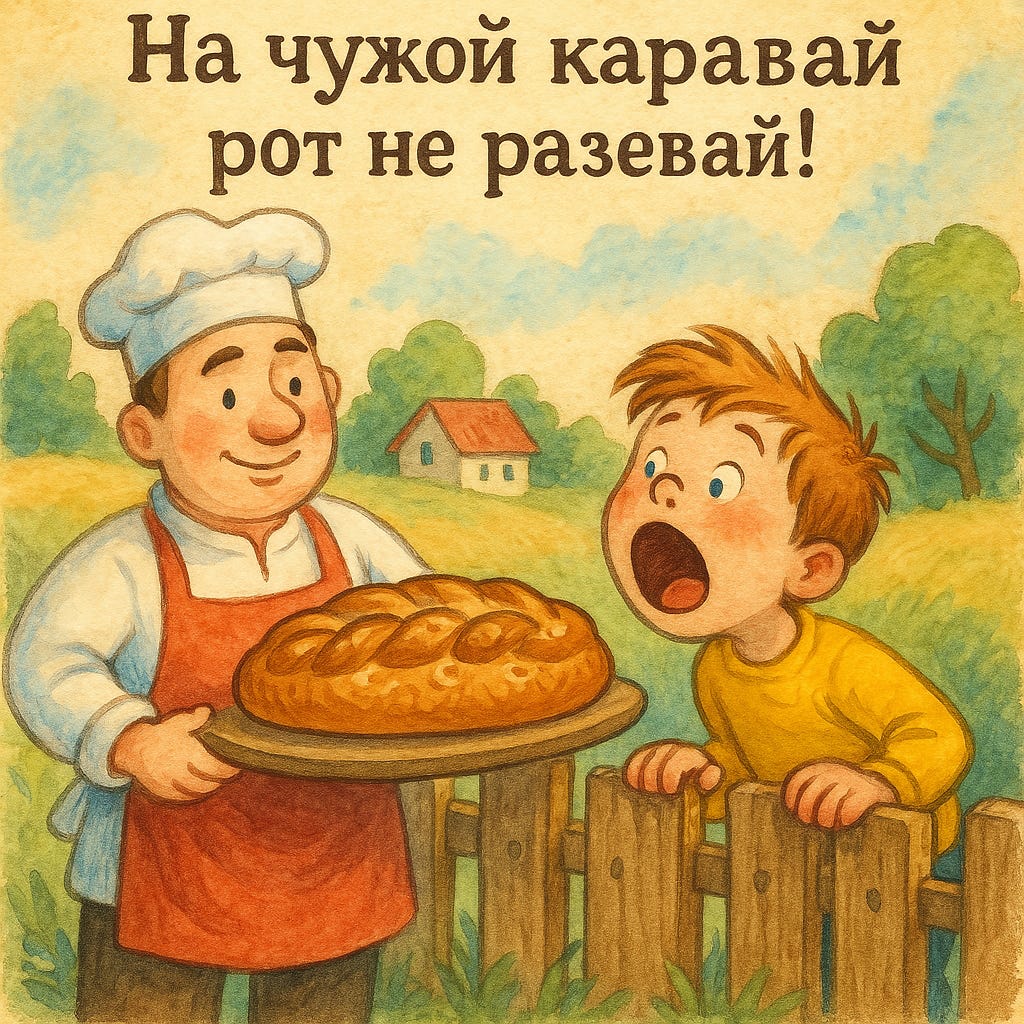
На чужой каравай рот не разевай!
This Russian proverb can be translated to English as follows:
Don’t open your mouth for someone else’s loaf of bread!
It’s a reminder to not be presumptuous with other people’s possessions.
разевай — open (your mouth) (old expression, somewhat rude or backward; verb, 2nd person singular, imperative mood; imperfective aspect; infinitive: разевать)
не — not (particle, used for negation)
не разевай рот — don’t open your mouth, keep your mouth shut, also metaphorically: pay attention, don’t daydream, stay focused)
Can also be used interchangeably with the object in genitive case:
не разевай рта
Все они пьяные, потные, с мутными глазами, напруживаясь и широко разевая рты, пели какую-то песню. - Л. Н. Толстой, “Война и мир”
(They were all drunk, sweaty, cloudy-eyed, gushing and with their mouths wide open, singing some kind of song. - L. N. Tolstoy, "War and Peace")
А если войдёт живая
милка, пасть разевая,
выгони не раздевая. - И. Бродский
(And if a lively little dear walks in,
mouth agape —
kick her out, clothes on, without delay. - J. Brodsky)
In the above quote, “разевая” is a gerund form (деепричастие) derived from the verb “разевать,” meaning “while opening the mouth wide” in this context. The word “пасть” usually translates to “mouth” for animals but can also refer to humans in a rude or derogatory manner.
рот — mouth (direct object; noun, masculine, singular, accusative case here)
Глянул в лицо — и лицо стало переменяться: нос вытянулся и повиснул над губами; рот в минуту раздался до ушей… - Н. В. Гоголь
(I looked into his face - and his face began to change: his nose stretched out and hung over his lips; his mouth was in a minute stretched up to his ears... - N. V. Gogol)
каравай — a round-shaped loaf of bread (usually used for special occasions; indirect )object, noun, masculine, singular, nominative case)
Большой каравай хлеба, накрошенный в квас лук да кусок красноватой солёной рыбы — был весь обед. - И. А. Гончаров
A large loaf of bread, onions crumbled in kvass, and a piece of reddish salted fish was the whole meal. - I. A. Goncharov
На — on/onto/to/at/for (depending on context)
preposition, used with the accusative case in this context
Приходи на меня посмотреть.
Приходи. Я живая. Мне больно. - Анна Ахматова
(Come and look at me.
Come. I'm alive. I'm in pain. - Anna Akhmatova)
чужой — someone else's (adjective, masculine singular nominative in this case, modifies "каравай")
The word “чужой” has more meanings than the base one. It’s a conceptual word — the antonym of “свой” (“one’s own”). It can be translated as “foreign”, “alien”, “unfamiliar”, “stranger”, or even “enemy”, depending on context. For example, the film Alien is known to Russian-speaking audiences as “Чужой.” The military radar identification system known in English as IFF (Identification, Friend or Foe) is called “Свой–чужой” in Russian.
Чужая даль. Чужой, чужой из труб
По рвам и шляпам шлёпающий дождик,
И, отчужденьем обращённый в дуб,
Чужой, как мельник пушкинский, художник. - Б. Пастернак
(A distant land — not mine. A stranger, too, the rain
That splashes down on ditches, hats, and stones.
And turned to oak by estrangement’s pain,
The artist stands — as alien as Pushkin’s miller moans. - B. Pasternak)