
Я вас любил...
I loved you, part 1

After a break to focus on proverbs and dialogues, we are going to return to reading poetry. Our first attempt was "The Sail" by M. Lermontov. If you missed it, please go that classic poem and enjoy reading it word by word with me in Russian.
This time, we will be reading "I Loved You," written by A. Pushkin in 1829.
Я вас любил: любовь еще, быть может,
В душе моей угасла не совсем;
Но пусть она вас больше не тревожит;
Я не хочу печалить вас ничем.
Я вас любил безмолвно, безнадежно,
То робостью, то ревностью томим;
Я вас любил так искренно, так нежно,
Как дай вам Бог любимой быть другим.
А. С. Пушкин, 1829
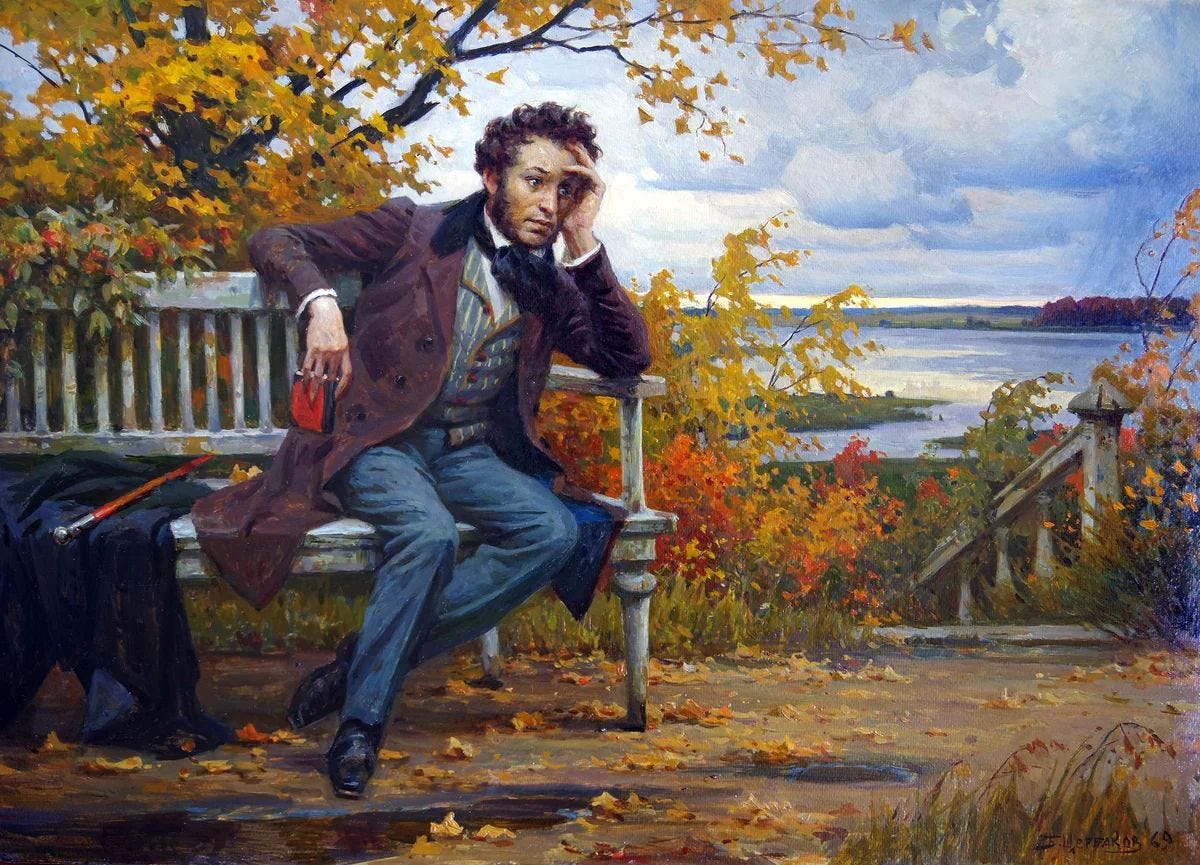
A. Pushkin in his Mikhailovskoe Estate, painting by Boris Shcherbakov, 1969
The famous poem by Alexander Pushkin, “Я вас любил...” (“I Loved You”), captures the essence of unrequited love and the nobility of letting go. It is arguably the most translated of Pushkin’s poems, and we are going to use some of these translations to explore the text.
Let’s start with the first two lines.
Я вас любил: любовь ещё, быть может,
В душе моей угасла не совсем;
can be literally translated as
I loved you; love still, perhaps,
Has in my soul died out not altogether;
“Я вас любил:”
Although "Я вас любил" is often translated as "I loved you," one might argue that, considering the words that follow and the differences between the languages, it may also mean:
I have loved you
I did love you
I used to love you
I have been in love with you
I was in love with you
and even, as Led Zeppelin put it, "I have been loving you."
It is also worth noting that the word order in a Russian sentence is not fixed in casual conversation, let alone in poetry. Moreover, the order and intonation can change the meaning of the sentence. Thus, "Я вас любил" and "Я любил вас" mean the same thing.
Я: "I" (pronoun, first person, singular, nominative case)
Нет, я не Байрон, я другой… - М. Лермонтов
Познал я глас иных желаний,
Познал я новую печаль… - А. С. Пушкин
вас: "you" (pronoun in formal or plural form, direct object in the accusative case, nominative form - вы)
Случайно вас когда-то встретя,
В вас искру нежности заметя,
Я ей поверить не посмел… - А. С. Пушкин
Дальше ваши рыжие кудри примелькаются, и вас просто начнут бить. - Илья Ильф и Евгений Петров «Золотой телёнок»
любил: "loved" (verb, predicate, past tense, masculine, singular, derived from the infinitive form "любить")
Ты меня не любишь, не жалеешь,
Разве я немного не красив? - С. Есенин
Люблю тебя сейчас
Не тайно — напоказ. - В. Высоцкий
As if to emphasize the ambiguity of the past tense in Russian, Pushkin uses a colon (":") after "любил" and continues with:
“любовь ещё, быть может,
В душе моей угасла не совсем;”
Again, in a casual, less poetic language this would be:
”может быть, любовь ещё не совсем угасла в моей душе”.
любовь: "love" (subject in the second independent clause, nominative case)
Моя любовь никому не принесла счастья… - М. Лермонтов
Вся любовь, все чувства, всё, что есть нежного и страстного в женщине, всё обратилось у ней в одно материнское чувство. - Н. В. Гоголь
ещё: "still" or "yet"
Он задумался ещё на прошлой станции и всё продолжал думать о том же… - Л. Н. Толстой
Ещё недавно сосны гнуло,
Скрипели ржавые стволы… - В. Тушнова
быть может: "perhaps" or "maybe" (adverb, with the same meaning as “может быть” or ”возможно”).
The fixed expression “быть может” consists of two separate words, each with its own meaning outside of the expression:
быть: "to be"
может: "may" or "can" (3rd person singular, present tense, gender-neutral)
Быть может, это всё пустое,
Обман неопытной души! - А. С. Пушкин
— Вы, быть может, ушиблись? - А. Грин
В душе моей (In my soul)
в: "in" (preposition)
душе: "soul" or "heart" (noun “душа”, feminine, singular, in the dative case)
моей: "my" (possessive pronoun “моя”, feminine, singular, in the dative case, agreeing with "душе")
В душе моей, как в океане,
Надежд разбитых груз лежит. - М. Лермонтов
И пламень мой, слабея постепенно,
Собою сам погас в душе моей. - Е. Баратынский
угасла: "has faded" or "has died down" (verb “угаснуть” in past tense, perfect, feminine, singular, predicate to the subject “любовь”; corresponding imperfect verb - “угасать”)
“Их страсти и надежды давно угасли вместе с ними…” - М. Лермонтов
”Затем сознание его угасло мгновенно, и наступил полный мрак.” - Ф. М. Достоевский
не совсем: "not completely" or "not entirely" (often used as fixed expression, consisting of the negative particle “не” and the adverb “совсем” - “completely”, “entirely”) In casual conversation, the Russian phrase “не совсем” is similar to the English “not exactly”.
“Этот вопрос со стороны Левина был не совсем добросовестен.” - Л. Н. Толстой
”Люблю говорить слова,
Не совсем подходящие.” - В. Ходасевич
And now please enjoy two opening lines that we have just read together translated by U. R. Bowie:
I loved you; love may still be so inclined
To fester in my soul amidst the rue;
and by Genia Gurarie:
I loved you, and I probably still do,
And for a while the feeling may remain...
Я вас любил...

In Part 1, we read together the first two lines from the famous poem by A. Pushkin, 'Я вас любил...'. In Part 2, we will read the next two lines.