
Я вас любил...
I loved you, part 2

In Part 1, we read together the first two lines from the famous poem by A. Pushkin, 'Я вас любил...'. In Part 2, we will read the next two lines.
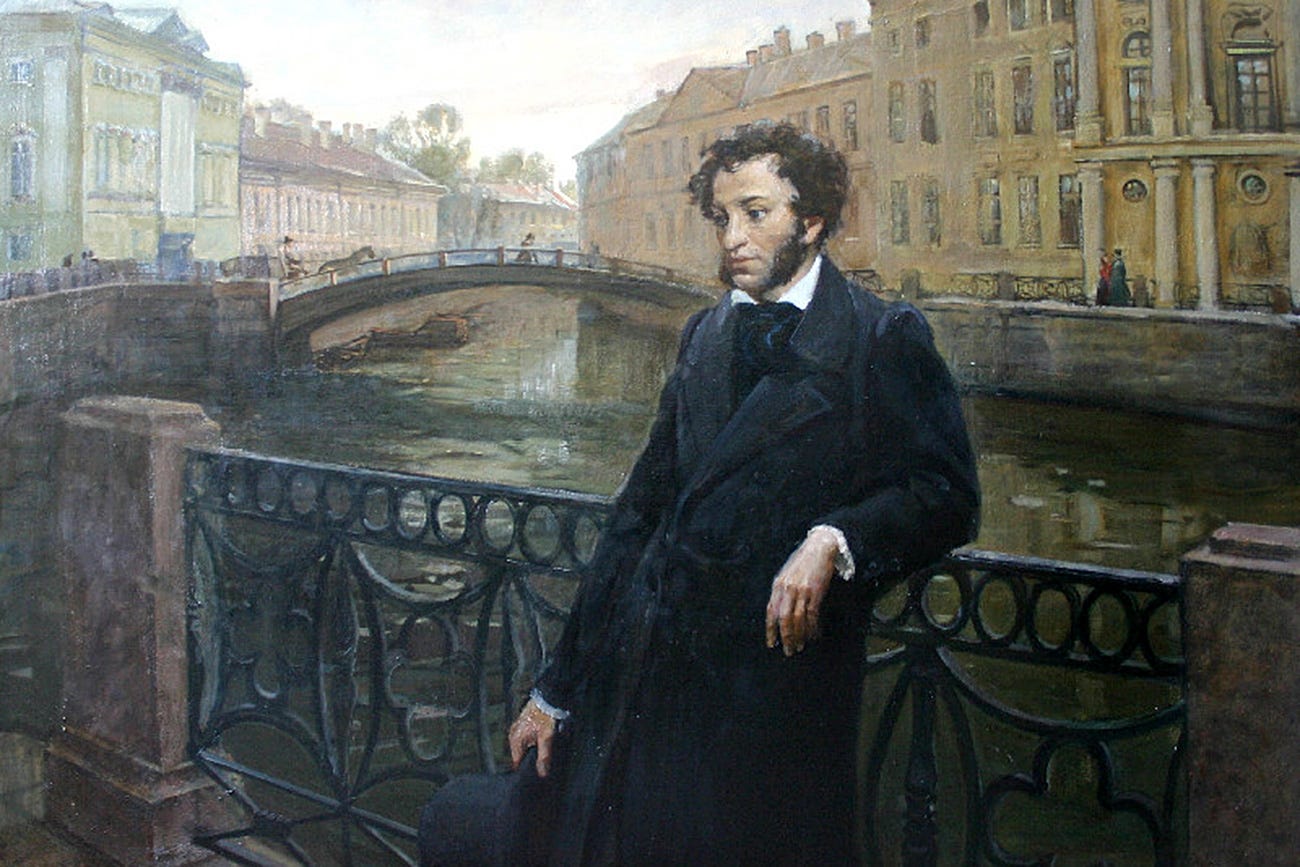
Pushkin on the Moika Canal Embankment in St. Petersburg, painting by Aleksandr Kravchuk
Но пусть она вас больше не тревожит;
Я не хочу печалить вас ничем.
It can be literally translated as:
But let it not disturb you anymore;
I do not want to sadden you with anything.
Но пусть она вас больше не тревожит;
Но - "But" (Conjunction, used to introduce a contrast or exception.)
Мы все живём как будто, но
Не будоражат нас давно
Ни паровозные свистки,
Ни пароходные гудки. - В. Высоцкий
пусть - "let" (Particle/Imperative, used to express a wish or request, implying a command.) In this context, it gives a somewhat softened imperative mood.
Пусть увозит меня теплоход
На закат, на восход.
Пусть поёт надо мною волна:
"Пей до дна, пей до дна!" - А. Суханов
она - "it", referring to the word “любовь” from the very first line of the poem. (Pronoun, third person singular, feminine, nominative case, subject of the sentence)
The pronoun “она” can also be translated to “she” in English. Read more about how personal pronouns in Russian differ from those in English (available to paid subscribers).
Она читала мир как роман
А он оказался повестью
Соседи по подъезду
Парни с прыщавой совестью - И. Кормильцев, В. Бутусов
вас - "you" (Pronoun, formal singular in this context, but could be second person plural in another context, accusative case, direct object of the sentence, in nominative case - “вы”)
Конечно, многих вы милей,
Но вас любить — плохая шутка! - Е. Баратынский
больше - ("more" or "anymore”, adverb, modifies the negated verb "не тревожит," indicating the extent or degree, “no longer disturb”)
Но Жизни на свете чуть больше, чем смерти,
И Света на свете чуть больше, чем тьмы. - А. Макаревич
не - "not" (particle, negates the verb "тревожит")
тревожит - ("disturb," "worry," or "trouble", verb, present tense, imperfective, indicating ongoing action, third person singular)
Есть минуты, когда не тревожит
Роковая нас жизни гроза.
Кто-то на плечи руки положит,
Кто-то ясно заглянет в глаза... - А. Блок
Я не хочу печалить вас ничем.
Я - "I" (Pronoun, first person singular, nominative case, subject of the sentence)
не - "not" (Particle, negates the verb "хочу")
хочу - "want" (Verb, present tense, imperfective, first person singular, infinitive form “хотеть”)
Вчера на улице ко мне подошла старуха и предложила купить вечную иглу для примуса. Вы знаете, Адам, я не купил. Мне не нужна вечная игла, я не хочу жить вечно. Я хочу умереть. - И. Ильф, У. Петров
“Golden Calf”, Mosfilm, 1968, feat. Serguey Yurskiy, director Mikhail Schveitser
печалить - "to sadden" or “to make you sad” (Verb, infinitive, imperfective)
И ныне, как тогда, вопрос меня печалит:
к каким он берегам неведомым причалит… - В. Набоков
вас - "you" (same as above: pronoun, formal singular in this context, but could be second person plural in another context, accusative case, direct object of the sentence, object of the verb "печалить", in nominative case - “вы”)
ничем - “with nothing”, Russian language allows for multiple negations in one sentence, and we have already seen “не хочу” in the same sentence. It should translate to "with anything" in our case. (Pronoun, instrumental case, in nominative case “ничто”)
Чужой для всех, ничем не связан,
Я думал: вольность и покой
Замена счастью. Боже мой!
Как я ошибся, как наказан. - А. Пушкин
Read by Artem Lyskov, @lyskov
Let us enjoy two poetic translations of these lines first by U. R. Bowie:
But this need not prey on your peace of mind;
I would not wish to vex or sadden you.
and then by Genia Gurarie:
But let my love no longer trouble you,
I do not wish to cause you any pain.