
На обиженных воду возят

The Russian proverb «На обиженных воду возят» literally translates to:
“Water is hauled on the offended.”
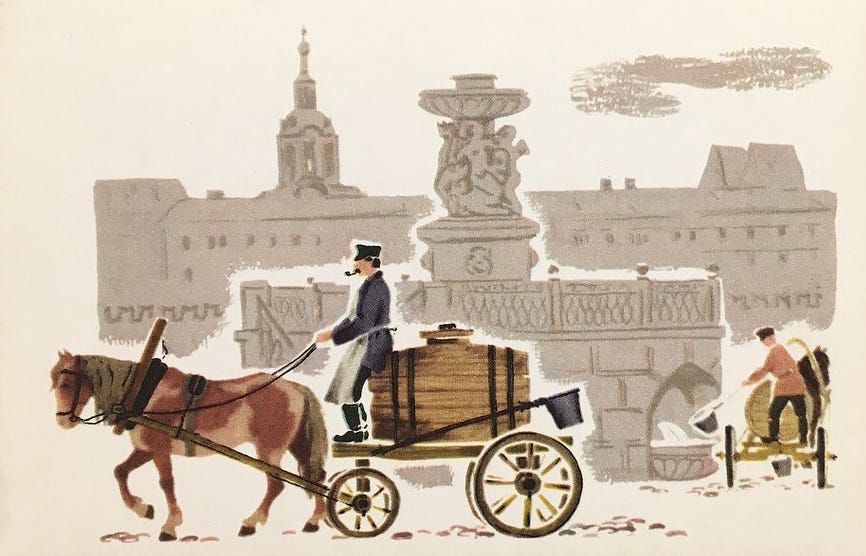
A mid-century postcard
It’s not a kind or sympathetic expression. With a dismissive or even mocking tone, it is often used to double down on an insult rather than offer an apology. Its meaning is similar to the English saying, “If you act like a doormat, expect to be stepped on.”
Like many Russian proverbs, this one is a generalized personal sentence (обобщённо-личное предложение): a sentence without an explicit subject, where the doer of the action is not specified, and which conveys general wisdom.
Let’s read it, word by word
На – on (preposition)
Other meanings: at, upon, onto, for depending on context.
На берегу пустынных волн
Стоял он, дум великих полн… - А. С. Пушкин
(On the shore of the desert waves
He stood there, full of great thoughts... - A. S. Pushkin)
обиженных – the offended (adjective used as a noun in plural form; prepositional case; nominative: обиженные)
As an adjective обиженный means offended, hurt, slighted.
А вы, надменные потомки
Известной подлостью прославленных отцов,
Пятою рабскою поправшие обломки
Игрою счастия обиженных родов! - М. Ю. Лермонтов
(And you, haughty descendants
Of your fathers famous by their meanness,
Who with slave’s foot have trampled upon the wreckage
Of the clans hurt by the fortune! - M. Y. Lermontov)
Read by Oleg Dal
воду – water (noun, feminine; direct object; accusative singular; nominative: вода)
И сапоги он скинул. И когда
Он в воду ноги опустил, вода
Заговорила с ним, не понимая,
Что он не знает языка её. - Арсений Тарковский
(And he threw off his boots. And when
He put his feet in the water,
The water spoke to him, not realizing
That he didn't know its language. - Arseny Tarkovsky)
Also: figuratively вода can refer to meaningless speech (e.g. “в тексте много воды”).
The fixed expression “по воду,” with emphasis on “по,” is often used colloquially instead of “за водой,” as in “пойти по воду” (“to go get water”), especially in rural areas where people have to walk to a communal tap or well to fetch water in buckets.
“А только, ваше высокоблагородие, разговаривать мне с тобой некогда, надо по воду идти.” - А. П. Чехов
("Only, your highness, I have no time to talk to you, I must go get water." - A. P. Chekhov)
возят – carry or transport (verb, imperfective; 3rd person plural, present tense; infinitive: возить)
We discussed this verb of motion in details here:
Везти vs. возить

The Russian verbs везти and возить are a pair of verbs of motion that both in their base meaning translate to to transport, to carry (usually by means of transportation), to take someone from place to place in a car, carriage, etc., in English, but they differ in terms of
Most Read Russian posts are public. We read poems and proverbs together, word by word. Feel free to share these public posts with friends who are interested in the Russian language.
Closer looks at Russian grammar are available to paid subscribers. If you find them helpful, consider subscribing yourself — or show your generosity by gifting a subscription to a friend.
I profoundly appreciate your support.