
Любишь кататься, люби и саночки возить
A motivational proverb

The proverb “Любишь кататься, люби и саночки возить” may seem like a semi-cryptic message with quite a few words implied. Let me decrypt it for you, adding all the implied words in brackets: (Если ты) любишь кататься (с горки), (то) люби и саночки возить (обратно в горку).
This can be translated into English as: “If you like sledding, then you must also like pulling the sled back uphill.” So, it’s sort of a motivator with an idea that one must be ready to deal with both the fun and the hard work that comes with it.
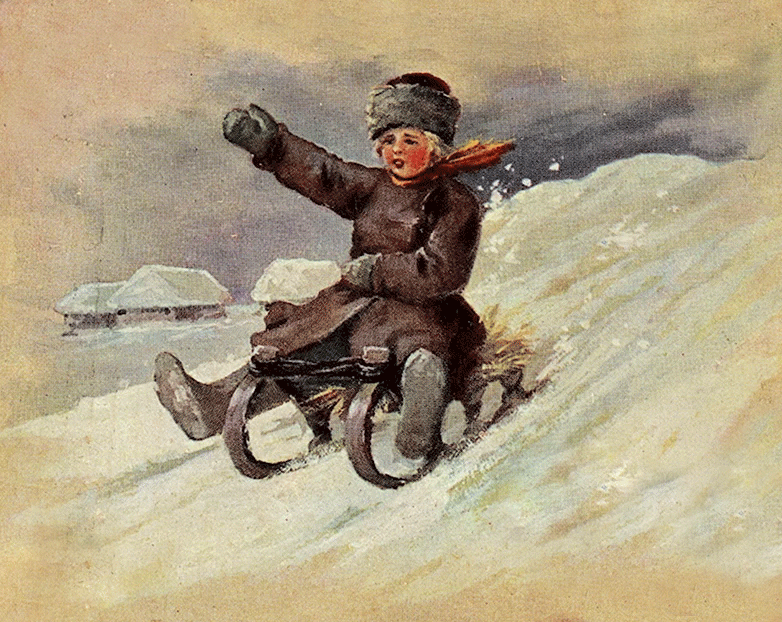
From an old Russian postcard
Now, let’s read it word by word.
Любишь – you like (verb, predicate of the subordinate clause with the implied “if”, 2nd person singular, present tense, infinitive: любить)
It can also mean “to love” in addition to “to like,” depending on context.
Ты меня не любишь, не жалеешь,
Разве я немного не красив? - С. Есенин
(Don't you love me, don't you pity me,
Am I not a little handsome? - S. Yesenin)
кататься – to ride / to sled (verb, infinitive form, reflexive (indicated by -ся)
Нельзя же целый век
Кататься нам в санях с Армидами младыми
Иль киснуть у печей за стёклами двойными. - А. С. Пушкин
(We can't spend a whole century
Going sledding with young Armida.
Or sulk by the stoves behind double-glazed windows. - A. S. Pushkin)
Performed by I. Smoktunovsky
Other meanings:
to roll;
to go for a ride in a car, train, bus;
to slide (e.g., skating, skiing).
люби – (you must) love / like (verb, imperative mood, 2nd person singular, infinitive: любить, same as above)
Люби лишь то, что редкостно и мнимо… - В. Набоков
(Like only what is rare and imaginary... - V. Nabokov)
и – is a particle that intensifies the meaning of the verb “возить”.
Приносят ко мне на почту письмо. Взглянул на адрес — вижу: «в Почтамтскую улицу». Я так и обомлел. - Н. В. Гоголь
(They bring a letter to me at the post office. I looked at the address and saw: "to Postamtskaya Street". I was just stunned. - N. V. Gogol)
Revizor, Mosfilm, 1952
“И” is also often used as a conjunction translating to “and”.
саночки – little sled (noun, accusative, plurale tantum, diminutive form of сани; nominative: саночки)
Ребятишки все на льду,
На пруду.
Дружно саночки визжат —
Едем в ряд! - Саша Чёрный
(The kids are all on the ice,
On the pond
The sleds are squealing together
Let's go in a row - Sasha Chorny)
возить – to pull / to transport / to carry repeatedly or habitually (verb, infinitive, imperfective aspect)
Хотели было на лето везти его за границу; но Татьяна Павловна настояла, чтоб не возить, да и он сам не захотел. - Ф. М. Достоевский
(We wanted to take him abroad for the summer, but Tatiana Pavlovna insisted that we should not take him, and he himself did not want to. - F. M. Dostoevsky)
This verb belongs to the pair of verbs of motion “везти–возить.” You can read more about this pair here:
